
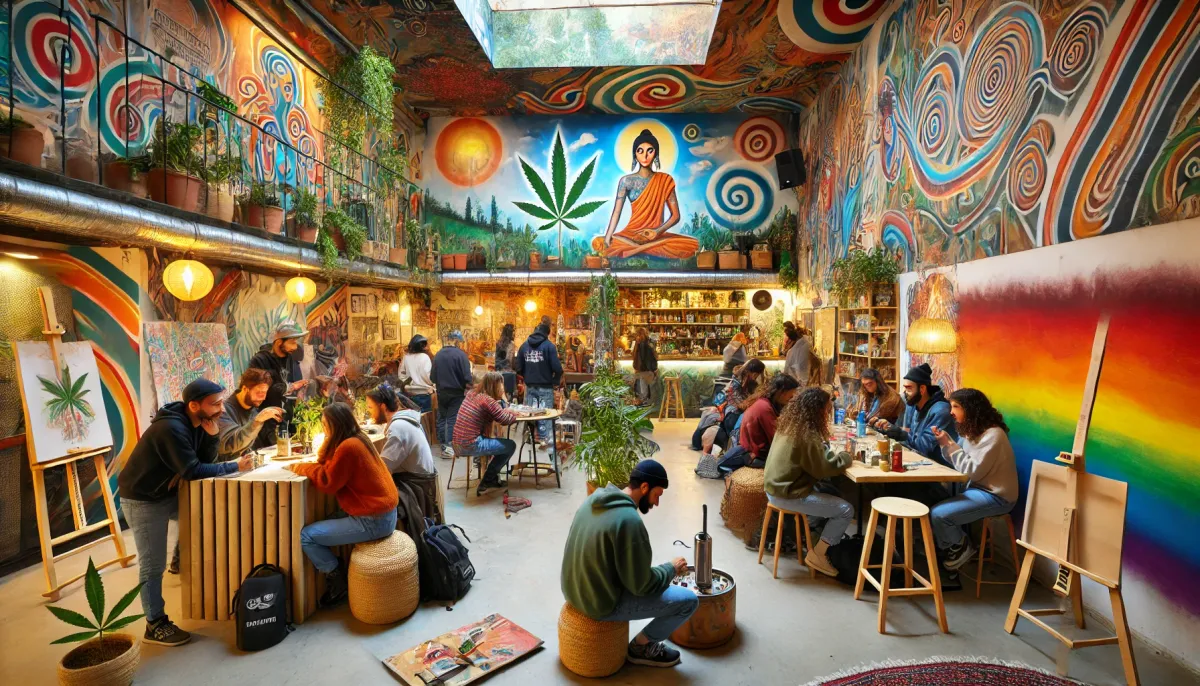
Community grows through repeated contact
The social element of a cannabis association is the relationship among its members: seeing familiar people, exchanging experiences and taking part in shared decisions. In Valencia, this happens within a city shaped by residents with different languages, origins and lengths of residence. The municipal 2025 population study documents this diversity across districts and neighbourhoods. It describes the city around the associations; club membership has its own composition.
A social space beyond a transaction
Research by Anna Obradors-Pineda and colleagues followed activity records for 2,007 members of five Barcelona clubs between 2017 and 2020. Average membership lasted 657.3 days, roughly a year and ten months. The authors describe clubs as places for socialising among people who use cannabis. A continuing relationship of that length gives community a different meaning from a single visit: familiarity can accumulate through ordinary encounters and a shared organisational setting.
Different relationships with the same club
The same study found that 80% of members were men. Women, older adults and people registered as medical users generally maintained longer memberships than average, while their collection frequency and quantities tended to be lower than those of younger recreational male members. Intensity of cannabis collection and duration of belonging can therefore differ. These findings also make gender and age visible in a discussion often reduced to a single stereotypical club member. They concern the Barcelona sample, not a census of Valencia.
Participation gives belonging a formal dimension
Under Spain's association law, members have rights to participate in activities and governing bodies, receive information and challenge decisions contrary to law or the statutes. The general assembly and the accounts therefore belong to a club's social life as much as informal conversation does. A member who can understand a meeting, ask about spending and raise a concern has a practical role in the organisation. Clear notices and an intelligible complaints process help make those rights usable.
Everyday inclusion is concrete
A welcoming association needs room for different reasons for participating and different levels of sociability. Someone may enjoy a long conversation; another may prefer a quieter interaction. Listening without pressure, respecting privacy and obtaining consent before photographing people are practical expressions of respect. In community life, inclusion also means that the loudest participants do not automatically decide for everyone. Belonging becomes durable when ordinary members can influence the shared space and remain themselves within it.
Sources & further reading
General information, not individual legal or medical advice.