
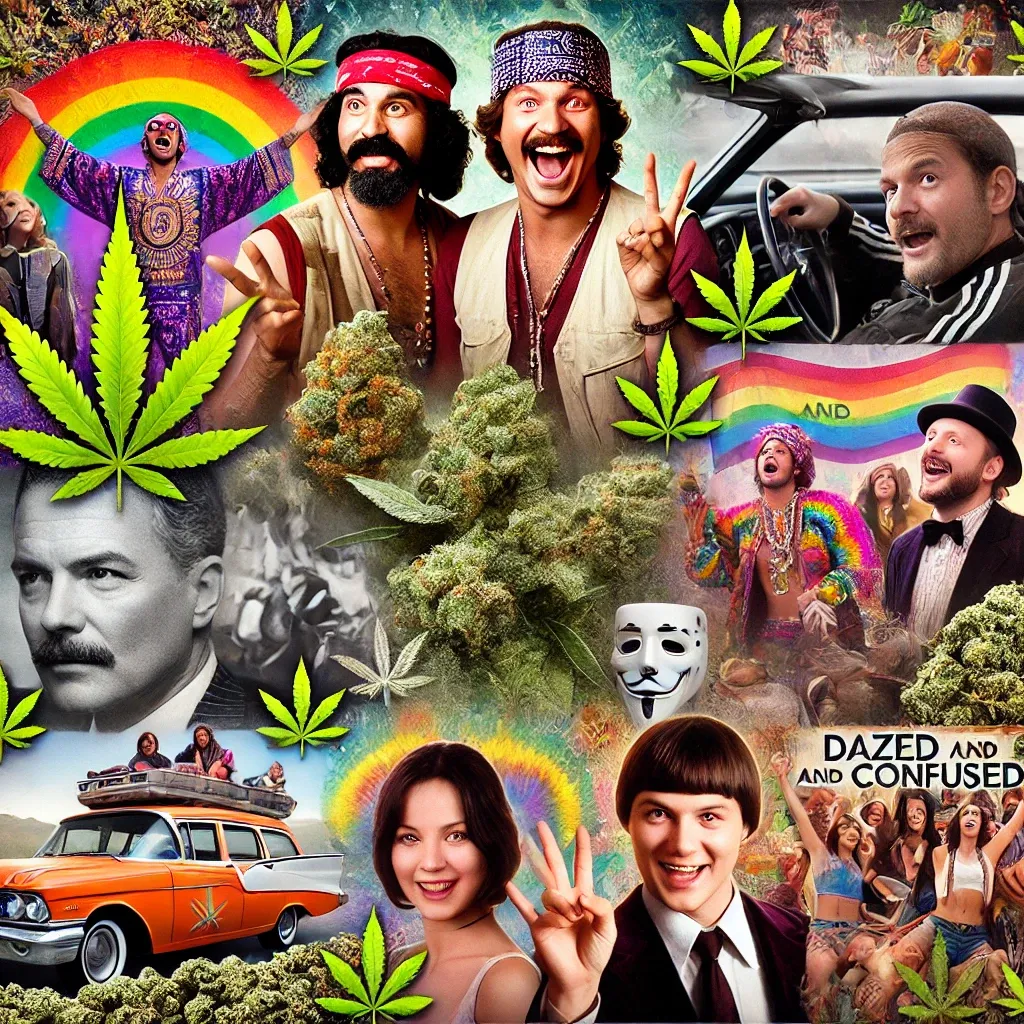
One plant, ten different storytelling jobs
These ten films are interesting together because cannabis performs different jobs in each: it triggers panic, joins friends, interrupts a journey or becomes a political subject. Most portray North American settings, so they illuminate the images that travel internationally rather than documenting Spanish association life. The contrast between genres is more revealing than treating them as a single celebration of cannabis.
Reefer Madness and Grass: a warning and its historical reversal
Reefer Madness, directed by Louis J. Gasnier in the 1930s, turns cannabis into an engine of catastrophe. Its extravagant fear is the point of the viewing experience today: a supposedly instructive film became a cult object whose tone later audiences could read against its intended message.
Grass (1999), Ron Mann’s documentary narrated by Woody Harrelson, makes prohibition itself the subject. Archival material lets the film examine the language and imagery surrounding US drug policy. Placing these two films together reveals how the same old footage can function first as persuasion and later as evidence of the way persuasion worked.
Up in Smoke and Half Baked: friendship drives the joke
Up in Smoke (1978) brings Cheech Marin and Tommy Chong’s comic partnership to the screen. Performance, music and the duo’s mismatched energy matter as much as plot. Cannabis provides a shared comic universe in which authority and ordinary expectations repeatedly become ridiculous.
Half Baked (1998), with Dave Chappelle, builds another group comedy around friends and an escalating attempt to solve trouble. Its comic vocabulary belongs to a later generation, but the structure is familiar: loyalty keeps the group together while improvised solutions multiply its problems. Neither film needs psychological realism to make that mechanism work.
Dazed and Confused and The Big Lebowski: atmosphere over a lesson
Dazed and Confused (1993) follows intersecting groups on the last day of school in 1976. Cannabis sits among music, boredom, social hierarchy and anticipation. Richard Linklater’s interest is in time spent together: the film gives hanging around the narrative weight another story might give a dramatic turning point.
The Big Lebowski (1998) puts the Dude’s unhurried presence inside a mistaken-identity crime plot. The contrast produces the comedy: an elaborate mystery meets someone whose priorities remain stubbornly modest. Cannabis contributes to characterization, but the film’s world is also shaped by bowling, status anxiety and conflicting ideas of masculinity.
Harold & Kumar and Pineapple Express: journeys that accelerate
Harold & Kumar Go to White Castle (2004) turns an ordinary food destination into an obstacle-filled journey. Its Asian American protagonists give the familiar buddy format a different perspective on stereotyping and belonging. Their shared objective makes the absurd diversions readable.
Pineapple Express (2008) changes the pace again. A witnessed murder forces the central pair into flight, joining stoner comedy to action cinema. The comic tension lies in characters poorly matched to the speed and violence of the plot suddenly required to behave like action heroes.
Super High Me and Humboldt County: the individual and the community
Super High Me follows comedian Doug Benson through a personal cannabis experiment. Its entertaining premise belongs to first-person documentary: personality, self-observation and editing shape the result. It is a portrait of an experience, not a controlled medical study.
Humboldt County (2008) follows a disillusioned medical student into a Northern Californian cannabis-growing community. The quieter drama shifts attention toward belonging and an alternative household. Ending with this film changes the question from what cannabis does to a comic plot to what kind of social world a filmmaker builds around it.
Sources & further reading
General information, not individual legal or medical advice.