
A festival built around the street
During Fallas, Valencia’s streets become workshops, meeting places and stages. Cannabis does not give this public celebration a separate legal status: the crowds, temporary enclosures and outdoor concerts remain part of the city’s public life. The festival’s distinctive sensory experience comes from its own materials—gunpowder, flowers, music and monumental sculpture.
Understanding those elements makes the event more intelligible than describing it simply as a party. A mascletà is organised around rhythm and explosive sound; the flower offering is a procession with a devotional destination; the final burning completes the life of a work made to disappear. These are different occasions, with different kinds of participation.
The falla: sculpture, satire and neighbourhood work
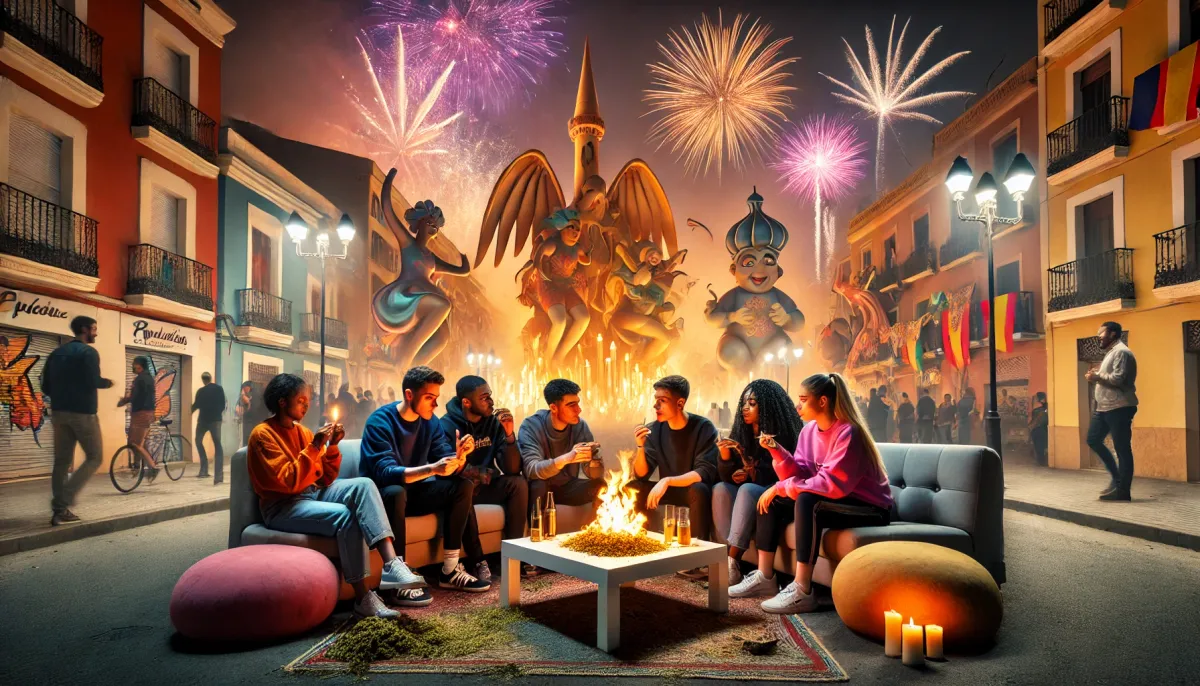
A falla is a large temporary monument populated by ninots, sculpted figures that often caricature recognisable social behaviour or current affairs. Looking at their expressions, arrangement and accompanying words reveals jokes that a photograph of the whole monument can miss. Humour and criticism are part of the form, alongside the technical work needed to construct it.
The neighbourhood commission, or comisión fallera, gives the celebration its local base. Preparations and community activity extend beyond the days when visitors see the monuments. UNESCO inscribed the Fallas festivity on its Representative List of the Intangible Cultural Heritage of Humanity in 2016, recognising a living tradition sustained through shared skills and participation.
Mascletà: sound with a structure
The traditional daily mascletà takes place in Plaza del Ayuntamiento at 14:00 from 1 to 19 March. It builds sequences of detonations into a rhythmic progression, with a force that is felt as well as heard. It is not the same spectacle as a nighttime fireworks display: sound and mounting intensity are central to its design.
This distinction matters when cannabis is presented as a way to heighten the festival. The event already delivers a powerful sensory environment. Intoxication is not needed to understand its rhythm, and a subjective feeling of intensity is different from a deeper understanding of the craft. The crowd and the noise also leave little opportunity to create a quiet, personally controlled setting.
Flowers change the atmosphere
On 17 and 18 March, falleros and falleras process toward Plaza de la Virgen for the offering to the Virgen de los Desamparados, Valencia’s patron saint. The flowers form the mantle of the large image in the square. Dress, bands and the movement of neighbourhood groups make this a different expression of the festival from the explosive sequences of the mascletà.
The offering also explains why Fallas cannot be reduced to nightlife. It brings together religious devotion, family participation, craftsmanship and civic identity. Flowers are a collective contribution to a temporary composition, just as the monuments bring many people’s work into a shared public space.
The cremà and the public-space boundary
The cremà on 19 March closes the cycle by burning the monuments. Their destruction is part of the tradition rather than an accidental loss of valuable sculpture: the work belongs to an annual sequence of creation, display and renewal.
Spain’s public-security law treats unlawful cannabis consumption or possession in public places as an administrative offence, including when possession is not intended for trafficking. Fallas provides no festival exemption. That boundary belongs in an account of cannabis and the celebration, but the event’s principal story remains the neighbourhood art, ceremonial flowers and carefully shaped sound that transform Valencia each March.
Sources & further reading
General information, not individual legal or medical advice.