
Feeling creative and producing creative work
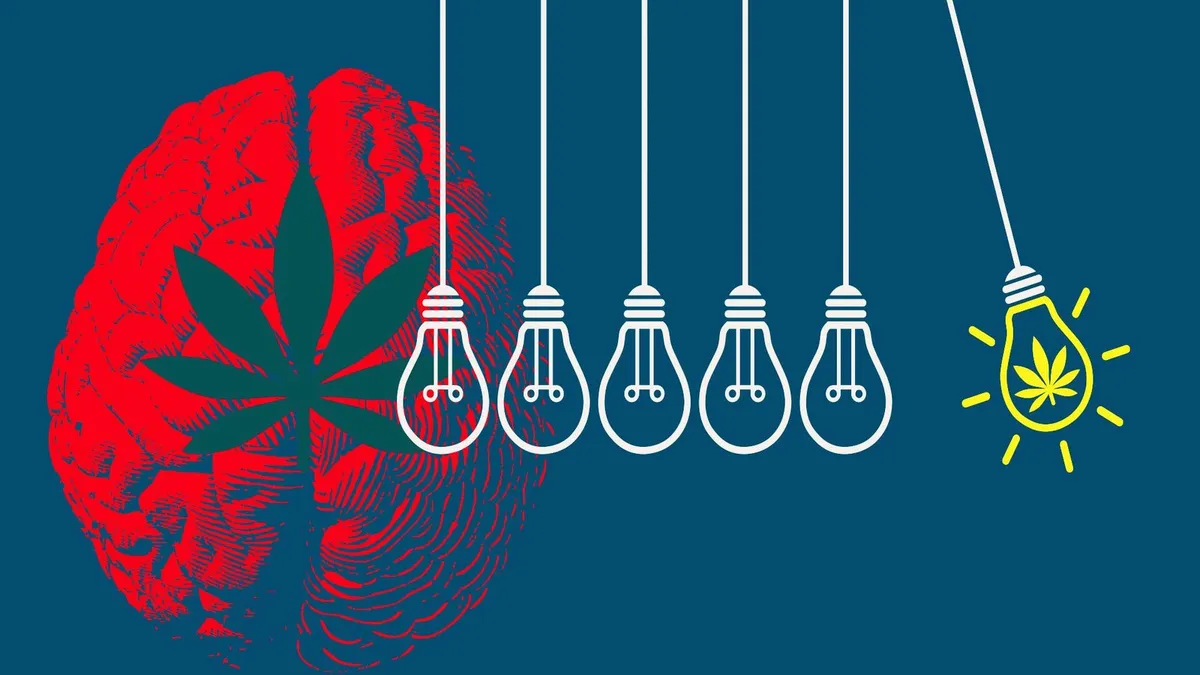
Cannabis can make ideas feel more exciting without improving their independently assessed creativity. That distinction emerged in experiments by Yu Tse Heng, Christopher Barnes and Kai Chi Yam, published online in 2022 and in the Journal of Applied Psychology in 2023. Cannabis use increased joviality, which was associated with more favourable judgments of ideas. The predicted improvement in creative performance was not supported.
A more generous judge of ideas
The researchers tested both people's judgments of their own ideas and their evaluations of other people's ideas. The positive shift extended to both. This matters because a creative experience contains several activities: generating possibilities, enjoying them, choosing among them and refining a final result. Enthusiasm can change during one of these stages while the quality of the resulting work remains similar. Someone's report of feeling inspired can describe a real change in experience without establishing that a song, design or solution improved.
What a controlled thinking task found
A separate randomised, double-blind study by Mikael Kowal and colleagues, published in Psychopharmacology in 2015, involved 54 regular cannabis users. Participants completed tasks involving divergent thinking, which generates multiple possible answers, and convergent thinking, which seeks a particular solution. The stronger THC condition produced worse divergent-thinking performance than both the lower condition and placebo. The lower condition did not outperform placebo. Performance on the convergent-thinking task did not differ significantly between conditions.
Originality has several ingredients
The divergent-thinking task asked for alternative uses of ordinary objects. Scoring considered such features as the number of ideas, their variety and their originality. These tests capture parts of creative thinking rather than an entire artistic career. Composing a finished piece also involves memory, technical skill, sustained attention, editing and feedback. A laboratory session therefore answers a narrower question than whether a particular musician's body of work was influenced by cannabis.
The practical distinction for creative work
The findings give a reason to separate first impressions from later evaluation. A writer can save a draft and revisit it; a designer can ask someone else to assess a proposal against its purpose. These are ordinary creative practices that make judgment less dependent on the mood of one moment. Across the studies described here, subjective appreciation was more favourable than the evidence for improved performance. The strongest positive finding concerned how ideas were experienced and rated, while the controlled study also identified a condition in which idea generation deteriorated.
Sources & further reading
General information, not individual legal or medical advice.